I Spent a Day Building a 440-Line Interceptor, Then Deleted It
Distributed tracing is one of those things that seems straightforward until you cross a process boundary. I recently needed end-to-end tracing across a stack comprising an API gateway (FastAPI), a processing microservice (FastAPI), and a Temporal worker. While HTTP tracing is trivial, moving a trace context from an API request into an asynchronous Temporal workflow — which might execute minutes later on an entirely different node — turned into a classic engineering rabbit hole.
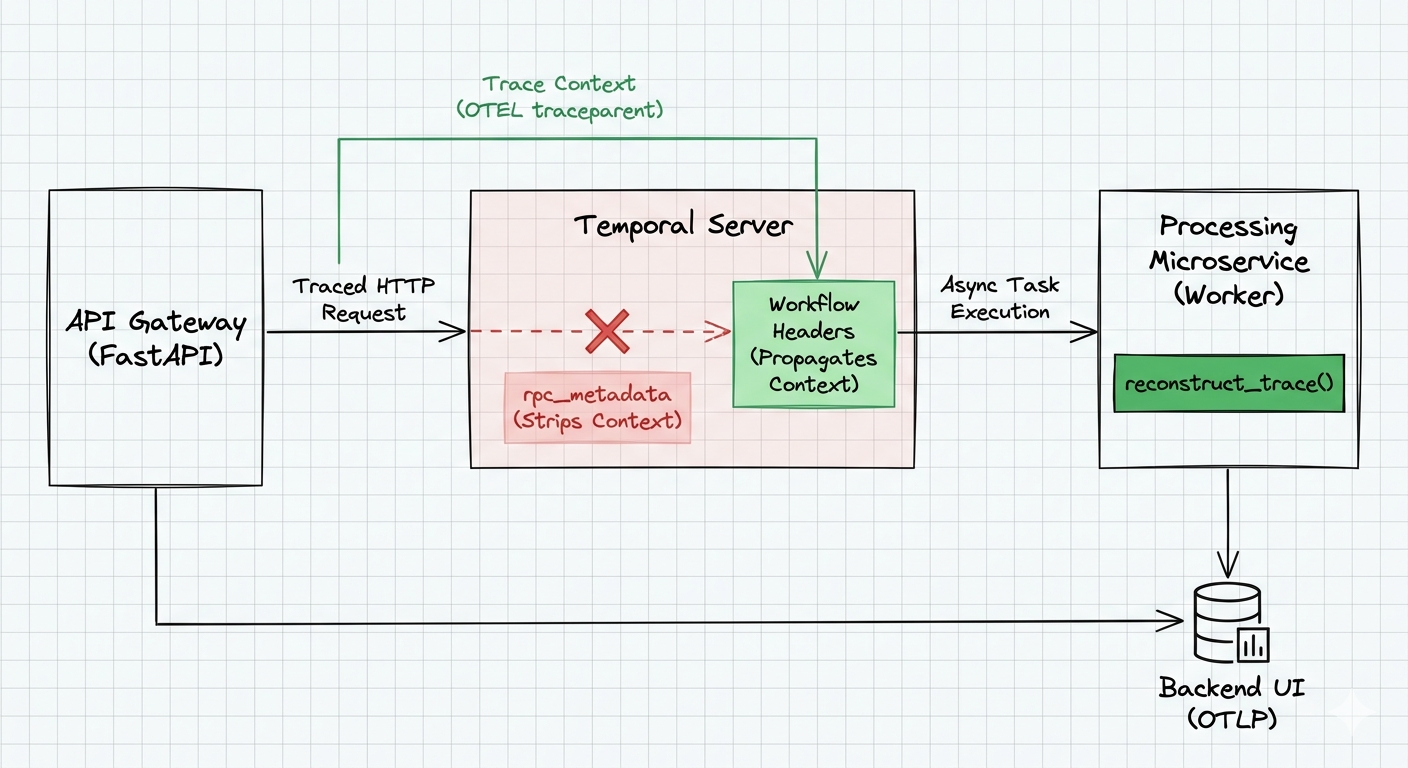
The detour into complexity
My first instinct was to leverage our existing SkyWalking infrastructure. I spent the better part of a day building a custom SkyWalking interceptor (a massive 440-line file) designed to manually extract the sw8 trace context and inject it into Temporal’s rpc_metadata.
It felt logical: Temporal uses gRPC, and metadata is the standard way to pass headers in gRPC. I pushed the code, ran the tests, and watched the trace context vanish into thin air.
My trace context was being discarded by the very framework I was trying to instrument. I then pivoted to a hybrid “dual-header” approach, trying to pipe both SkyWalking and OpenTelemetry (OTEL) context through workflow headers. It was a fragile, messy architecture that left me with four different debug files committed to the repo — a vivid reminder of the time I’d wasted wrestling with the framework.
The realization
Frustrated, I stepped back and looked at the ecosystem again. The breakthrough came when I realized two things:
- Wrong transport. Temporal
rpc_metadatais for gRPC transport, not business logic. For cross-process context propagation, you must use workflow headers. - Native support. I was treating SkyWalking as a proprietary silo when I should have been using it as an OTLP-compatible backend. SkyWalking OAP v9+ natively ingests OTEL traces. I didn’t need the SkyWalking Python agent; I just needed to export via OTLP.
The clean solution
I deleted the 440-line custom interceptor and replaced it with the official temporalio.contrib.opentelemetry.TracingInterceptor.
This library is designed exactly for this use case. It automatically handles the injection and extraction of traceparent headers through Temporal’s workflow headers, following the OTEL standard. To handle the “noise” — the influx of internal ASGI calls and Dapr gRPC overhead that made my UI look like a mess — I implemented a _FilteringExporter wrapper. This acts as a final gatekeeper, dropping unwanted spans by name before they ever leave the process, ensuring my trace view remains clean and actionable.
Lessons in tooling
The biggest takeaway here is the danger of “custom-built complexity.” I had spent a day trying to reinvent standardized propagation logic that the Temporal and OpenTelemetry teams had already perfected.
When you find yourself writing hundreds of lines of code to force a framework to pass data, stop. You are likely fighting the architecture rather than using it. Modern observability is increasingly standardized around OpenTelemetry; if your stack supports OTLP, lean into it. Often, the best solution isn’t the one you build — it’s the one you find in the documentation that makes your custom code obsolete.